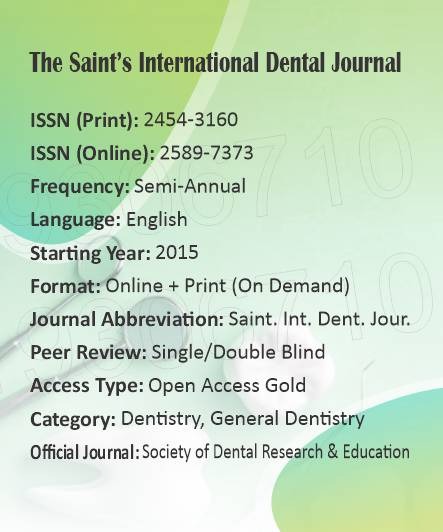


Instructions For Authors
Welcome Author, Researcher, Academician
Thank You for Considering Open Access unique journal title The Saint's International Dental Journal (SIDJ) official Society of Dental Research & Education (SDRE)
About the Journal
A manuscript will be reviewed for possible publication with the understanding that it is being submitted to The Saint's International Dental Journal alone at that point in time and has not been published anywhere, simultaneously submitted, or already accepted for publication elsewhere. The journal expects authors to authorize one of them to correspond with the Journal for all matters related to the manuscript. All manuscripts received are duly acknowledged. On submission, editors review all submitted manuscripts initially for suitability for formal review. Manuscripts with insufficient originality, serious scientific or technical flaws, or lack of a significant message are rejected before proceeding for formal peer-review. Manuscripts that are not of interest to The Saint's International Dental Journal readers are liable to be rejected at any stage before final acceptance.
Manuscripts found suitable for publication in The Saint's International Dental Journal are sent to two expert reviewers for blind peer review. During submission, the corresponding author is requested to provide the names of two or three qualified reviewers who have experience in the subject matter of the submitted manuscript, but this is not mandatory. Reviewers should not be affiliated with the same institutions as the contributor/s. However, the selection of these reviewers depends on the sole discretion of the editor. The journal follows a double-blind review process, in which reviewers and authors are unaware of each other's identities. Each manuscript is also assigned to a member of the editorial team, who makes the final decision on the manuscript based on the reviewer's comments. Comments and suggestions received from the reviewers (acceptance/rejection/revision of the manuscript) and editor are conveyed to the corresponding author. If necessary, the author is requested to provide point-by-point feedback on the reviewer's comments and present a revised manuscript version. This process is repeated until the reviewer and editor are satisfied with the manuscript.
Manuscripts accepted for publication are copy edited for grammar, punctuation, print style, and format. Page proofs are sent to the corresponding author. The corresponding author is expected to return the corrected proofs within three-seven days. It may not be possible to incorporate corrections received after that period. The Process of Submitting the manuscript to the final decision and sending and receiving proofs are completed online. To achieve faster and greater dissemination of knowledge and information, the journal publishes articles online as 'Ahead of Print' immediately on acceptance. The Saint's International Dental Journal Editors Reviewed all Submitted Manuscript Initially. Manuscript Found insufficient Originality, absence of new messages, serious scientific flaws are rejected without sending for Peer Review.
If the manuscript confirms the journal's scope and is found suitable by the editor of SIDJ, it is sent for a double-blind peer review process; the manuscript will be sent to two or more expert peer reviewers for review without revealing the manuscript author's identities. Within a period of Four to Six Weeks (Expected 28 working Days + 02 Weeks for Stats and Results Check), the corresponding author will be informed about the reviewer's comments with Revision/Minor Revision/Major Revision/Acceptance/Rejection of manuscript. Once the manuscript is accepted for publication it will be copy edited for Grammar and Language Corrections, Reference Check, Stats Check, punctuation, print and style format as per Journal Instructions and Guidelines.
Scope of the Journal
The journal will encompass studies related to oral & Maxillofacial health with associated structures, advanced treatments, advanced surgical techniques, and new biomaterials. It will also address emerging frontiers and the ethical considerations in multi-speciality dental care, including head and neck surgery, all specialities of dentistry, and oncosurgery. Authors can submit various article types, such as Original Research, Invited Editorial & Guest Editorials, Reviews, Meta-Analyses, Technical Notes, Pictorial Essays, Case Reports, and Letters to the Editor. The journal aims to enhance scientific standards and promote significant research, with a preference for articles focused on Experimental and Translational Research, as well as Innovative and Clinical Trials with clinical relevance.
ORCID SIDJ - https://orcid.org/0000-0001-5090-1470
IMPORTANT INSTRUCTION FOR AUTHORS PRIOR TO SUBMISSION
Authors are strongly encouraged to read all the "Instructions For Authors" before submitting the manuscript to the journal SIDJ. If a manuscript fails to meet the preparation standards outlined in the SIDJ guidelines (As per Journal Policies & Instructions For Authors), it will be returned to the authors for necessary technical modifications prior to undergoing the editorial review process. The manuscript should be structured with Covering Letter, Title Page, Main Manuscript, Contributors Form, Copyright Form, Images, and Tables as per instructions in the templates. Editorial Staff/Journal Editors will not be involved in the processing of their own academic work. The Editorial staff/editor's written original submission will be assigned to at least two independent external reviewers for review. Decisions will be made by other editorial board members who have no conflict of interest with the author.
TIME TAKEN FOR PROCESSING OF MANUSCRIPT
- Submission of Manuscript via Author Zone or Submit Paper Submit New Manuscript.
- Editorial review of the submitted article must follow SIDJ author instructions; otherwise, the manuscript will be returned to the author for technical corrections.
- Editorial Review - 5-7 Days (If sent for Revised should be submitted again as the time given as per instructions SIDJ)
- Peer Review: The review period consists of 28 days, followed by an additional 14 days for statistical evaluation, if applicable. Should the manuscript be returned for revisions, the revised article must be resubmitted in accordance with the instructions provided by SIDJ.
- Publication on acceptance shall depend on the manuscript's date of acceptance and category (original research, review, case reports, etc.)
- The author can track the entire process through their log in the dashboard, and in case of queries, they can email the editor (editor.sidj@gmail.com) through their login page of the journal software (editor query)
- Any query to the editor shall be responded to by email in 5-7 working days
ANTI PLAGIARISM POLICY
Plagiarism includes the duplicate publication of the author's own work, in whole or in part, without proper citation or mispresenting others' ideas, words, and other creative expressions as one's own. The Journal follows a strict anti-plagiarism policy. All manuscripts submitted to The Saint's International Dental Journal will undergo a plagiarism check with commercially available software. Based on the extent of plagiarism, authors may be asked to address any minor duplication or similarity with previously published work. If plagiarism is detected after publication, the Journal will investigate. If plagiarism is established, the journal will notify the authors' institution and funding bodies and will retract the plagiarized article. To report plagiarism, contact the journal office (email: editor@sidj.org / editor.sidj@gmail.com)
Clinical trial registry
The Saint's International Dental Journal favors registration of clinical trials and is a signatory to the Statement on publishing clinical trials in Indian biomedical journals. The Saint's International Dental Journal would publish clinical trials that have been registered with a clinical trial registry that allows free online access to public. Registration in the following trial registers is acceptable: https://ctri.nic.in/Clinicaltrials/login.php, http://www.clinicaltrials.gov/, http://isrctn.org/ and http://www.umin.ac.jp/ctr. This is applicable to clinical trials that have begun enrollment of subjects in or after June 2008. Clinical trials that have commenced enrollment of subjects prior to June 2008 would be considered for publication in The Saint's International Dental Journal only if they have been registered retrospectively with clinical trial registry that allows unhindered online access to public without charging any fees.
Authorship Criteria
Authorship credit should be based only on substantial contributions to each of the three components mentioned below:
- Concept and design of study or acquisition of data or analysis and interpretation of data;
- Drafting the article or revising it critically for important intellectual content; and
- Final approval of the version to be published.
Participation solely in the acquisition of funding or the collection of data does not justify authorship. General supervision of the research group is not sufficient for authorship. Each contributor should have participated sufficiently in the work to take public responsibility for appropriate portions of the content of the manuscript. The order of naming the contributors should be based on the relative contribution of the contributor towards the study and writing the manuscript. Once submitted the order cannot be changed without written consent of all the contributors. The journal prescribes a maximum number of authors for manuscripts depending upon the type of manuscript, its scope and number of institutions involved. The authors should provide a justification, if the number of authors exceeds these limits.
Contribution Details
Contributors are requested to provide a comprehensive description of their contributions to the manuscript, organized into the following categories as applicable: concept, design, definition of intellectual content, literature search, clinical studies, experimental studies, data acquisition, data analysis, statistical analysis, manuscript preparation, manuscript editing, and manuscript review. These contributions will be published alongside the article. Additionally, one or more authors should assume responsibility for the integrity of the work as a whole, from its inception to the final published version, and should be designated as the "guarantor."
Conflicts of Interest/ Competing Interests/Declarations
All authors of articles must disclose any and all conflicts of interest (Financial, Affiliations, Intellectual Property, Personal, Ideology, Academic etc) they may have with publication of the manuscript or an institution or product that is mentioned in the manuscript and/or is important to the outcome of the study presented. Authors should also disclose conflict of interest with products that compete with those mentioned in their manuscript.
Submission of Manuscripts
All manuscripts must be submitted online through the website www.sidj.org (Submit New Manuscript). First-time users must register on this site. Registration is free and mandatory. Registered authors can keep track of their articles after logging into the site using their username and password. Authors do not have to pay for submission, processing, or publication of articles. If you experience any problems, For any inquiries, please reach out to the editorial office via email at editor.sidj@gmail.com, editor@sidj.org or sdre@sidjsdre.org. Your correspondence will be addressed promptly.
The submitted manuscripts that are not as per the "Instructions For Authors" would be returned to the authors for technical correction, before they undergo editorial/peer-review. Generally, the manuscript should be submitted in the form of separate files (Title Page, Covering Letter, Main Manuscript, Figures, Graphs and Tables, Supplementary Files).
Editor in Chief
Dr Nirma Yadav (Associate Professor)
Dept of Dentistry
Maa Vindhyawasini Autonomous State Medical College
Mirzapur Uttar Pradesh India
Mob. No: +91-9838158061
Email: editor@sidj.org, editor.sidj@gmail.com
Society of Dental Research & Education (For Publishing/Print) - Correspondence
House No-717, Uttari Dharamshala Krishna Nagar
Zone- 8 Jhunsi Prayagraj
Uttar Pradesh- 211019
Email: sdre@sidjsdre.org
Preparation of Manuscripts
Manuscripts must be prepared in accordance with "Recommendations for the Conduct, Reporting, Editing and Publication of Scholarly Work in Medical Journals" (Updated URMs ICMJE Recommendations) for Manuscripts submitted to 'The Saint's International Dental Journal,' developed by the International Committee of Medical Journal Editors (URMs October 2008). The uniform and specific requirements of The Saint's International Dental Journal are summarized below. Before submitting a manuscript, contributors are requested to check for the latest instructions available. Instructions are accessible on the journal's website (http://www.sidj.org), specifically within the Author Zone (Author Instructions) and the Journal Policies section. All figures and Tables must be referred to in the manuscript. Only the Title page should bear the names and addresses of the author(s).
[1] Title Page/First Page File/covering letter:
Submit Covering Letter in Covering Letter section which should include why your paper should be accepted for publication including followings important points:
- Covering Letter Signed by All Authors
- Information of Prior or Duplicate publication or has submitted somewhere else also
- Statement of Financial or other relationship that might lead to conflict of interest
- Name, Emailid, Institutional Address including Department and Mobile Number of Corresponding Author
- Work in Original and Free of Plagiarism
- Article Title in Original Research should include Design of the Research. E.g. Prospective, Randomised, Blinded, Case Control etc
Title Page should provide (Authorship should be According to ICMJE Recommendation 2018):
- The type of manuscript (original article, case report, review article, Letter to editor, case series, Images, etc.) title of the manuscript, running title, names of all authors/contributors (designation and affiliations), and name(s) of department(s) and/or institution(s)/ORCID ID to which the work should be credited. All information that has the potential to disclose your identity should be documented in this section. Use text/doc files. Do not zip the files.
- The total number of pages, the total number of photographs, and word counts separately for Abstract and for the Text (excluding the Abstract, References, Tables, and Graphs), word counts for Introduction, Results + discussion in case of an original article;
- Source(s) of support in the form of grants, equipment, drugs, or all of these;
- Acknowledgment, if any. One or more statements should specify 1) contributions that need acknowledging but do not justify authorship, such as general support by a departmental chair; 2) acknowledgments of technical help; and 3) acknowledgments of financial and material support, which should specify the nature of the support. This should be included in the title page of the manuscript and not in the Main Manuscript.
- If the manuscript was presented as part of a meeting, conference, the organization, place, and exact date on which it was read should be provided.
- Registration number in case of a clinical trial and where it is registered (name of the registry and its URL)
- Conflicts of Interest of each author/contributor
- Criteria for inclusion in the authors'/contributors' list
- A statement that the manuscript has been read and approved by all the listed authors
- The name, address, e-mail, department, designation, institutional address, and telephone number of the corresponding author
- Large Language Models (LLMs), such as ChatGPT, do not qualify for authorship, as authorship requires accountability that LLMs cannot provide. If you use an LLM, please document it in the Materials & Methods section or another relevant part of the manuscript.
[2] Running Title
A concise running title, limited to a maximum of 50 characters, must be included in both the cover letter and the title page. It is essential to adhere to this character limit to ensure clarity and consistency throughout the submission.
[3] Types Of Manuscripts
[i] Editorial / Guest Editorial
Submissions are accepted exclusively through invitation via email. If you are interested in submitting your work, please reach out to us at editor.sidj@gmail.com. We encourage you to provide as much detail as possible in your communication, as thoroughness is appreciated.
[ii] Original Research
The title of original research must be descriptive, precise, and accurate, effectively reflecting the essential components of the study. It should also indicate the type of research conducted, such as a cross-sectional study, epidemiological study etc. Original research comprises systematic studies that aim to significantly enhance decision-making processes in various domains, including clinical dentistry, community oral health, oral health care policy, and oral and maxillofacial education.
Article Title in Original Research should include Design of the Research. E.g. Prospective, Randomised, Blinded, Case Control etc. These include randomized controlled trials, intervention studies, studies of screening and diagnostic tests, laboratory & animal studies, surveys with high response rate, outcome studies, cost-effectiveness analyses, case-control study, and surveys with a high response rate. The text of original articles amounting to up to 3000 words (excluding Abstract, references, and Tables) should be divided into sections with the headings Abstract, Key-words (Mesh Terms) Introduction, Material and Methods, Results, Discussion, References up to 30-40 (Include 70-80% Pubmed, SCOPUS, WoS, DOAJ Index Journals & should be concise & comprehensive, Current within 10-15 years), Tables and Figures (Maximum 8-10) Legends, Acknowledgement, Consent, Ethical committee approval, conflict of interest etc.
{1} Abstract (Semi Structured Summary)
The Abstract (Upto 300 Words) Should be structured and Follow IMRAD Format:
- Avoid/Minimize using of Abbreviation and do not Cite References in abstract part
- Introduction shall contain - Context (Background), Aims, Settings and Design, Methods and Material, Statistical analysis used, Results, Discussions and Conclusion
- For Randomized Trial Abstract should be in CONSORT Extension
- Below the abstract should provide 5 to 7 Keywords (Should be in Alphabetical Order). It is crucial to use keywords based on the Medical Subject Headings (MeSH) listed in the National Library of Medicine
- Include Strength and Limitations of the Research just below the Abstract in 300-500 words
{2} Introduction
The Introduction should be of Upto 300 Words, and State the purpose and summarize the rationale for the study or observation. The introduction should give a general overview of the study and explain why it is important.
{3} Materials & Methods
It should include the objectives, design, and setting of the study. A description of the participant characteristics, inclusion & exclusion criteria or the materials utilized. A detailed explanation of all processes, interventions, and comparisons. An overview of the statistical analysis conducted.
Ethics: When reporting studies on human beings, indicate whether the procedures followed were in accordance with the ethical standards of the responsible committee on human experimentation (institutional or regional) and with the Helsinki Declaration of 1975, as revised in 2000. For prospective studies involving human participants, authors are expected to mention about approval of Ethics Committee or Review Board, obtaining informed consent from adult research participants and obtaining assent for children aged over 7 years participating in the trial.
{4} Study design
Selection and Description of Participants: Describe your selection of the observational or experimental participants clearly, including eligibility and exclusion criteria. Technical information: Identify the methods, apparatus, and procedures in sufficient detail. Give references (Include 70-80% Pubmed, SCOPUS, WoS, DOAJ index Journals & should be within 15 years) to established methods.
Reporting Guidelines for Specific Study Designs
| Guideline | Type of Study | Source |
|---|---|---|
| STROBE | Observational studies including cohort, case-control, and cross-sectional studies | Link |
| CONSORT | Randomized controlled trials | Link |
| SQUIRE | Quality improvement projects | Link |
| PRISMA | Systematic reviews and meta-analyses | Link |
| STARD | Studies of diagnostic accuracy | Link |
| CARE | Case Reports | Link |
| AGREE | Clinical Practice Guidelines | Link |
{5} Statistics
Whenever possible, quantify findings and present them with appropriate indicators of measurement error or uncertainty (such as confidence intervals). When data are summarized in the Results section, specify the statistical methods used to analyze them. Use upper italics (P 0.048). For all P values, include the exact value and not less than 0.05 or 0.001.
{6} Results
Present your results in a logical sequence in the text, tables, and illustrations, giving the main or most important findings first. Do not repeat in the text all the data in the tables or illustrations; emphasize or summarize only important observations.
{7} Discussion/Conclusion
Include summary of key findings; Strengths and limitations of the study; Interpretation and implications in the context of the totality of evidence; Controversies raised by this study; and Future research directions. About 30-40 references (Include 70-80% PubMed, SCOPUS, Web of Sciences, DOAJ Index Journals & should be within 10-15 years) can be included. These articles generally should not have more than six authors.
[iii] Review Articles (SANRA Guidelines)
Should be submitted as per SANRA guidelines of Narrative Review. Should have a structured abstract which should explain the importance and aim of the review. The prescribed word count is up to 3000 words, excluding tables, references, and abstract. The manuscript may have about 30-40 references (Include 70-80% PubMed, SCOPUS, Web of Sciences, DOAJ Index Journals & should be within 10-15 years). The manuscript should have an unstructured Abstract (250 words) representing an accurate summary of the article.
[iv] Case Reports
New, interesting, and rare cases can be reported as per CARE guidelines and CARE checklist (Title, Abstract, Keywords, Introduction, Patient Information, Clinical Findings, Timeline, Diagnostic Assessments, Therapeutic Intervention, Follow-Up & Outcomes, Patients Perspective and Informed Consent). They should be unique, describing a great diagnostic or therapeutic challenge and providing a learning point for the readers. The manuscript could be of up to 1500-2000 words (excluding references and abstract) and could be supported with up to 10-15 references & maximum of 5-6 Pictures (Include 70-80% PubMed, SCOPUS, Web of Sciences, DOAJ Index Journals & should be within 10-15 years). Case Reports could be authored by up to four-Six authors.
[v] Clinico-Pathologic Conferences (CPC)
Should be Interesting, up to 1000 words (excluding references and abstract), Unusual, challenging with new updates. CPC should include Clinical Work with differential diagnosis. Abstract is not compulsory for CPC; instead, the author can mention key points of the submitted CPC (i.e., interesting points of CPC in 500-1000 words). CPC should include Title, Interesting Points, Clinical presentation in support of pictures (maximum 5-6), Diagnosis, Management & follow-up with Discussion. Can be Authored up to Four Authors.
[vi] Letter to the Editor & Correspondence
These should be short and decisive observations. They should preferably be related to articles previously published in the Journal or views expressed in the journal. The letter could have up to 500 words, 1 figure and 5 references (Include 70-80% PubMed, SCOPUS, Web of Science, DOAJ Index Journals). It could be generally authored by not more than four authors.
[vii] Conclusion
Manuscript end with conclusion or with summary point should briefly cover the key points of manuscript as SIDJ specific format. It should include new information so that it could deliver educational and teaching messages to SIDJ clinicians and readers.
[viii] References (Vancouver System)
References should be Comprehensive & Current (Include 70-80% PubMed, SCOPUS, Web of Sciences, DOAJ Index Journals & should be within 10-15 years of published literatures)
The reference list at the end of the manuscript must be numbered in the order of appearance and should be cited as follows:
- Names and initials of up to six authors. When there are seven or more, list the first six and add et al.
- Full title of paper followed by a full stop (.)
- Title of journal in the standard MEDLINE/indexing Abbreviation
- Year of publication
- Volume number followed by a comma (,)
- First page in full and the last digit of the last pages
References should be numbered consecutively in the order in which they are first mentioned in the text (not in alphabetic order). Identify references in text, tables, and legends by Arabic numerals in superscript with square bracket after the punctuation marks. Use the style of the examples below, which are based on the formats used by the NLM in Index Medicus.
[ix] Citation Rules and Policies (COPE citation manipulation)
- Authors should ensure in their manuscript that material taken from other sources (including their own published writings) the source should be clearly cited, and that appropriate permission has been obtained.
- Authors should not engage in excessive self-citation of their own work.
- Authors should not copy references from other publications if they have not read the cited work.
- Authors should not preferentially cite their own or their friends', peers', or institution's publications.
- Authors should not cite advertisements or advertorial material.
(a) Articles in Journals
- Standard journal article (for up to six authors): Parija S C, Ravinder PT, Shariff M. Detection of hydatid antigen in the fluid samples from hydatid cysts by co-agglutination. Trans. R.Soc. Trop. Med. Hyg.1996; 90:255–256.
- Standard journal article (for more than six authors): List the first six contributors followed by et al.: Roddy P, Goiri J, Flevaud L, Palma PP, Morote S, Lima N. et al., Field Evaluation of a Rapid Immunochromatographic Assay for Detection of Trypanosoma cruzi Infection by Use of Whole Blood. J. Clin. Microbiol. 2008; 46: 2022-2027.
- Volume with supplement: Otranto D, Capelli G, Genchi C: Changing distribution patterns of canine vector borne diseases in Italy: leishmaniosis vs. dirofilariosis. Parasites & Vectors 2009; Suppl 1:S2.
(b) Books and Other Monographs
- Personal author(s): Parija SC. Textbook of Medical Parasitology. 3rd ed. All India Publishers and Distributors. 2008.
- Editor(s), compiler(s) as author: Garcia LS, Filarial Nematodes In: Garcia LS (editor) Diagnostic Medical Parasitology ASM press Washington DC 2007: pp 319-356.
- Chapter in a book: Nesheim M C. Ascariasis and human nutrition. In Ascariasis and its prevention and control, D. W. T. Crompton, M. C. Nesbemi, and Z. S. Pawlowski (eds.). Taylor and Francis, London, U.K.1989, pp. 87–100.
(c) Electronic Sources as reference
Journal article on the Internet: Parija SC, Khairnar K. Detection of excretory Entamoeba histolytica DNA in the urine, and detection of E. histolytica DNA and lectin antigen in the liver abscess pus for the diagnosis of amoebic liver abscess. BMC Microbiology 2007, 7:41.doi:10.1186/1471-2180-7-41. http://www.biomedcentral.com/1471-2180/7/41
[x] Tables
- Tables should be self-explanatory and should not duplicate textual material. Should not contain tonal or shaded areas. should be of 900 to 1200 dpi.
- Tables with more than 10 columns and 25 rows are not acceptable.
- Number tables, in Arabic numerals, consecutively in the order of their first citation in the text and supply a brief title for each.
- Place explanatory matter in footnotes, not in the heading.
- Explain in footnotes all non-standard abbreviations that are used in each table.
- Obtain permission for all fully borrowed, adapted, and modified tables and provide a credit line in the footnote.
- For footnotes use the following symbols, in this sequence: *, †, ‡, §, ||,¶ , **, ††, ‡‡
- Tables with their legends should be provided at the end of the text after the references. The tables along with their number should be cited at the relevant place in the text
[xi] Illustrations (Figures)
- Upload the images in JPEG format. The file size should be within 1024 kb in size while uploading. Should be of 300 dpi or more.
- Figures should be numbered consecutively according to the order in which they have been first cited in the text.
- Halftone images a continuous tone photograph which contains no text should be of 300 dpi or more
- Combo images (i.e. images contains Halftone and text or line art elements) should be of 500 to 900 dpi
- Labels, numbers, and symbols should be clear and of uniform size.
- Symbols, arrows, or letters used in photomicrographs should contrast with the background.
- Titles and detailed explanations belong in the legends for illustrations not on the illustrations themselves.
- When graphs, scatter-grams or histograms are submitted the numerical data on which they are based should also be supplied.
- The photographs and figures should be trimmed to remove all the unwanted areas.
- If photographs of individuals are used, their pictures must be accompanied by written permission to use the photograph.
- If a figure has been published elsewhere, acknowledge the original source and submit written permission from the copyright holder to reproduce the material.
- Legends for illustrations: Type or print out legends (maximum 40 words, excluding the credit line) for illustrations using double spacing, with Arabic numerals corresponding to the illustrations.
- The Journal reserves the right to crop, rotate, reduce, or enlarge the photographs to an acceptable size.
[xii] Sending a revised manuscript
The revised version of the manuscript should be submitted online in a manner similar to that used for submission of the manuscript for the first time. However, there is no need to submit the "First Page" or "Covering Letter" file while submitting a revised version. When submitting a revised manuscript, contributors are requested to include, the 'referees' remarks along with point-to-point clarification (in underline and with different COLOR to save time) at the beginning in the revised file itself. In addition, they are expected to mark the changes as underlined or colored text in the article.
[xiii] Blinded Article file
The main text of the article, beginning from Abstract till References (including tables) should be in this file. The file must not contain any mention of the authors' names or initials or the institution at which the study was done or acknowledgements. Page headers/running title can include the title but not the authors' names. Manuscripts not in compliance with the Journal's blinding policy will be returned to the corresponding author. Use doc files. Do not zip the files. Limit the file size to 2 MB. Do not incorporate images in the file. If file size is large, graphs can be submitted as images separately without incorporating them in the article file to reduce the size of the file. The pages should be numbered consecutively, beginning with the first page of the blinded article file.
[xiv] Images
Submit good quality color images. Each image should be less than 2 MB in size. Do not incorporate the image in main manuscript and should be submitted separately. Size of the image can be reduced by decreasing the actual height and width of the images (keep up to 1600 x 1200 pixels (300 dpi or more) or 5-6 inches). Images can be submitted as jpeg files. Do not zip the files. Legends for the figures/images should be included at the end of the article file.
[xv] The copyright process
The copyright process is now digital and would be accepted by the corresponding author on behalf of all co-authors to streamline manuscript submissions. If required Journal can ask a signed Copyright form from all the authors which need to be Print, signed with date and email on Editor or Publisher given email. Please follow these guidelines for a smooth submission process:
- The submitting author must ensure that all co-authors, with their correct email addresses [mandatory], are added in the 'Authors and Institutions' section during the third step of online submission.
- After submission, all co-authors will receive an email with a link to provide their digital copyright consent. Please ensure all co-authors complete this process within seven days of submission.
- The submitting author can track the copyright status of their co-authors in the 'Manuscript Information' page by clicking the manuscript ID on their dashboard.
- Do not upload scanned copies of signed copyright forms during submission.
- Manuscript review will proceed only after all co-authors have submitted their digital copyright consent.
Upon acceptance of the article for publication, the authors will transfer, assign, or otherwise convey all copyright ownership, including all associated rights, exclusively to the Journal.
Protection of Patients' Rights to Privacy
Identifying information should not be published in written descriptions, photographs, sonograms, CT scans, etc., and pedigrees unless the information is essential for scientific purposes and the patient (or parent or guardian, wherever applicable) gives informed consent for publication. Authors should remove patients' names from figures unless they have obtained informed consent from the patients. The journal abides by ICMJE guidelines:
- Authors, not the journals nor the publisher, need to obtain the patient consent form before the publication and have the form properly archived. The consent forms are not to be uploaded with the cover letter or sent through email to editorial or publisher offices.
- If the manuscript contains patient images that preclude anonymity, or a description that has obvious indication to the identity of the patient, a statement about obtaining informed patient consent should be indicated in the manuscript.
Declaration of Authorship
All persons designated as authors should qualify for authorship, and all those who qualify should be listed. Each author should have participated sufficiently in the work to take public responsibility for appropriate portions of the content. One or more authors should take responsibility for the integrity of the work as a whole, from inception to published article. The name and order of the authors cannot be changed once the article is provisionally accepted.
Conditions 1, 2, 3 and 4 must all be met. Acquisition of funding, the collection of data, downloading references or general supervision of the research group, by themselves, do not justify authorship. Please read ICMJE guidelines in details at ICMJE Website
The order of authorship on the byline should be a joint decision of the co-authors. Authors should be prepared to explain the order in which authors are listed. Once submitted the order cannot be changed without written consent of all the authors. Unless all authors have read, reviewed, and approved, the manuscript, it would NOT be processed.
Reprints and proofs
Journal provides no free printed reprints. Authors can purchase reprints, payment for which should be done at the time of submitting the proofs.
Publication schedules
The journal publishes articles (After Approval Final Galley Proof by Corresponding Author) on its website immediately on acceptance and follows a 'continuous publication' schedule. Articles are compiled for 'print on demand' semi-annual issues.
Manuscript submission, processing, and publication charges (Open Access Fees)
The journal charges following fees for all types of articles on acceptance:
{a} Article Publication Fee (INR 5825/- or USD 65)* towards:
- World Wide Open Access of Full Text Manuscript
- Developing & Maintenance of Electronic Tools for Peer Review & Publication
- Preparation of Manuscript in various formats for online & Print Version
- Enabling Electronic Citations in other journals via secure inclusion in Crossref
- Increased Visibility and Enhanced Citations
- Global Collaborations, Greater Transparency and Compliance with mandates
(** The mentioned price is inclusive of GST and other taxes)
{b} Proclamation of Manuscript after Publication
- ORCID - https://orcid.org/
- LOOP - https://loop.frontiersin.org/
- Research Gate - https://www.researchgate.net/
- Mendeley - https://www.mendeley.com/
- Kudos - https://www.growkudos.com/about/researchers
- FigShare - https://figshare.com/
- DataCite - https://datacite.org/
- Google Scholar - https://scholar.google.com/
Copyrights
The entire contents of The Saint's International Dental Journal are protected under Indian and international copyrights. The Journal, however, grants to all users a free, irrevocable, worldwide, perpetual right of access to, and a license to copy, use, distribute, perform, and display the work publicly and to make and distribute derivative works in any digital medium for any reasonable non-commercial purpose, subject to proper attribution of authorship and ownership of the rights. The journal also grants the right to make small numbers of printed copies for their personal non-commercial use under Creative Commons Attribution-Non-commercial-Share Alike 4.0 International Public License.
Checklist
Covering letter
- Signed by all contributors
- Previous publication/presentations mentioned
- Source of funding mentioned
- Conflicts of interest disclosed
Authors
- Last name and given name provided along with Middle name initials (where applicable)
- Author for correspondence, with e-mail address provided
- Number of contributors restricted as per the instructions
- Identity not revealed in paper except title page (e.g. name of the institute in Methods, citing previous study as 'our study', names on figure labels, name of institute in photographs, etc.)
Presentation and format
- Double spacing
- Margins 1.0 cm from all four sides
- Page numbers included at bottom
- Title page contains all the desired information
- Running title provided (not more than 50 characters)
- Abstract page contains the full title of the manuscript
- Abstract provided (structured abstract of 250-300 words for original articles, unstructured abstracts of about 300 words for all other manuscripts excluding letters to the Editor)
- Key words provided (Five-Seven) {MeSH Term as Per NLM}
- Introduction of upto 300 words
- Headings in title case (not ALL CAPITALS)
- The references cited in the text should be after punctuation marks, in superscript with square bracket
- References according to the journal's instructions, punctuation marks checked
- Send the article file without 'Track Changes'
Language and grammar
- Uniformly American English
- Write the full term for each abbreviation at its first use in the title, abstract, keywords and text separately unless it is a standard unit of measure. Numerals from 1 to 10 spelt out
- Numerals at the beginning of the sentence spelt out
- Check the manuscript for spelling, grammar and punctuation errors
- If a brand name is cited, supply the manufacturer's name and address (city and state/country)
- Species names should be in italics
Tables and figures
- No repetition of data in tables and graphs and in text
- Actual numbers from which graphs drawn, provided
- Figures necessary and of good quality (colour)
- Table and figure numbers in Arabic letters (not Roman)
- Labels pasted on back of the photographs (no names written)
- Figure legends provided (not more than 40 words)
- Patients' privacy maintained (if not permission taken)
- Credit note for borrowed figures/tables provided
- Write the full term for each abbreviation used in the table as a footnote