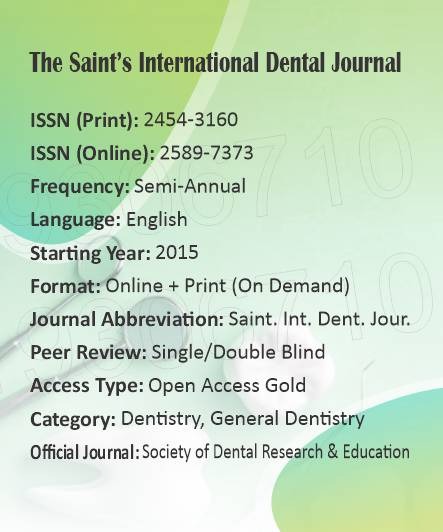


Scope of the Journal
The journal will encompass studies related to oral & Maxillofacial health with associated structures, advanced treatments, advanced surgical techniques, and new biomaterials. It will also address emerging frontiers and the ethical considerations in multi-speciality dental care, including head and neck surgery, all specialities of dentistry, and oncosurgery. Authors can submit various article types, such as Original Research, Invited Editorial & Guest Editorials, Reviews, Meta-Analyses, Technical Notes, Pictorial Essays, Case Reports, and Letters to the Editor. The journal aims to enhance scientific standards and promote significant research, with a preference for articles focused on Experimental and Translational Research, as well as Innovative and Clinical Trials with clinical relevance.
Abstracting and Indexing Information
The journal is listed & abstracted in:
Baidu Scholar, CNKI (China National Knowledge Infrastructure), EBSCO Publishing's Electronic Databases, Ex Libris – Primo Central, Google Scholar, Hinari, Infotrieve, National Science Library, Netherlands ISSN centre, ProQuest, TDNet, Wanfang Data
The journal is indexed with, or included in:
DOAJ
Journal Policies
The SDRE as an official web publisher & for Print is a respected source of information committed to high standards. We ensure our journals, editorials, and policies reflect excellence through thorough editorial assessments and rigorous blind peer reviews. Each stage of the publishing process, from editing to final publication, is handled with care and professionalism. The Saint's International Dental Journal (SIDJ) maintains exceptionally high publication standards, and as a publisher, the SDRE team is resolutely committed to ensuring that our editorial processes align with our principles of excellence. Our experienced team establishes SDRE as a leader in scholarly publishing and a reliable resource for students, researchers, academicians, and readers.
Confidence in our journals is founded on a rigorous peer-review process and a steadfast commitment to maintaining high standards. We delineate the responsibilities of reviewers, authors, and editors, and we adhere to policies concerning diversity and the application of Artificial Intelligence (AI). Our authors and external peer reviewers collaborate closely with expert editors to produce high-quality research that advances global health and well-being.
The Saint's International Dental Journal underscores the critical importance of strictly adhering to the comprehensive Recommendations for the Conduct, Reporting, Editing, and Publication of Scholarly Work. These guidelines, meticulously formulated by the esteemed International Committee of Medical Journal Editors (ICMJE), WAME (World Association of Medical Editors) and COPE (Committee of Publication Ethics) serve as a foundational framework for authors to ensure the integrity, rigor, and transparency of their scholarly contributions to the field of medical literature.
Editorial & Peer Review Policies
Each submission undergoes a technical evaluation according to the author guidelines. Submissions are assessed for formatting, scope, and quality. If suitable, in need of revisions, or extensive revisions involves detailed checking, then submitted article proceed to a pre-editorial (by inhouse team of expert Editors) review for preliminary feedback involves checking for inconsistencies & inaccuracies. Next, the submissions enter a rigorous double-blind peer review (author may also suggest two subject reviewers at the time of submission), where subject experts evaluate their originality, novelty, relevance, methodology, contributions, and overall scientific quality to ensure they meet the journal's high standards for publication. Authors can generally expect to receive a decision regarding their manuscript submission within a period of 20 to 28 days (3-4 weeks). Please keep in mind that the duration may vary based on factors such as the complexity of the work, the availability of reviewers, and the specific journal's review process.
Corresponding, First, Co-Senior Authorship (According to ICMJE Recommendation 2018)
The SIDJ journal permits only one corresponding author for each manuscript submission. This individual is fully responsible for all communications with the journal and will receive all correspondence pertaining to submission forms, authorship issues, manuscript files, and other related matters. Editors at SIDJ will engage exclusively with the corresponding author regarding submissions.
According to the International Committee of Medical Journal Editors (ICMJE) Recommendations, authorship credit requires:
- Significant contributions to the conception and design of the study, along with the acquisition, analysis, or interpretation of data.
- Drafting the article or making critical revisions to improve its intellectual rigor.
- Final approval of the version prepared for publication.
- Commitment to accountability for all aspects of the work, ensuring that any inquiries regarding the accuracy or integrity of any part of the article are properly investigated and addressed.
Contributors who do not meet all four authorship criteria should not be listed as authors but acknowledged instead. Activities that do not qualify for authorship include obtaining funding, general supervision, administrative support, and writing or editing assistance. Those who don't meet the authorship criteria may be acknowledged individually or as a group.
All individuals listed as authors of an article published in SIDJ are required to have made significant and identifiable contributions to the design, performance, analysis, and reporting of the work. Additionally, all authors must acknowledge their accountability for every aspect of the work. Before a manuscript can be published, it is essential that each author signs a formal statement affirming that they meet the authorship criteria as outlined in the International Committee of Medical Journal Editors (ICMJE) Recommendations.
Implementation of AI-Assisted Technologies
When utilizing artificial intelligence (such as large language models, chatbots, or image creators) for writing assistance, it is important to formally acknowledge its contribution in the acknowledgment section of your work. This recognition not only gives credit to the technology but also enhances transparency regarding the tools employed in the writing process. Authors must ensure that their materials, including AI-generated text and images, are free of plagiarism. All quotations should be properly attributed with full citations. Citing AI-generated content as a primary source is not allowed.
Guidelines for Editors
The core editorial team of The Saint's International Dental Journal (SIDJ) includes respected professionals with extensive expertise in dentistry. These team members, primarily academicians and senior practitioners from top dental colleges worldwide and specialized clinics, engage actively in teaching, research, and patient care. Their experience ensures high quality in the journal's publications. A key responsibility is the manuscript review process, where each submission is carefully evaluated, with no rejections made without consensus from at least one editor. This collaborative approach fosters thorough evaluation and balanced decision-making. The editors also oversee the peer review process, ensuring effective communication between reviewers and authors while maintaining review integrity. Their combined expertise guides decisions on manuscript acceptance or rejection, ultimately advancing dental research, education, and practice.
The International Committee of Medical Journal Editors (ICMJE) adheres to the World Association of Medical Editors (WAME) {https://wame.org/editorial-independence} definition of editorial freedom, which indicates that editors-in-chief possess complete authority over the editorial content and the timing of publication. Editors responsible for making final decisions on manuscripts must recuse themselves in instances where potential conflicts of interest are present. Additionally, other editorial staff involved in the decision-making process should disclose any relevant relationships and recuse themselves from decisions where such conflicts may arise.
The SIDJ Journal, officially published by the Society of Dental Research and Education (SDRE), is required to implement thorough precautions and establish a formal policy for the evaluation of manuscripts submitted by individuals participating in the editorial decision-making process. For further guidance, resources are available from the Committee on Publication Ethics (COPE) and the World Association of Medical Editors (WAME)
Guidelines for Peer Reviewers
SIDJ maintains a comprehensive global database of peer reviewers with diverse expertise across a wide range of specialties in dentistry and its related disciplines. Each submission is typically assessed by one/two blind peer reviewers over a period of two to three weeks. Following their evaluation, they provide written reports and feedback in English for the editors' consideration. All submitted manuscripts are treated as confidential communications. Reviewers are selected at the discretion of the journal's editor based on the specific request for evaluation.
Authors are granted the opportunity to recommend up to two potential reviewers when submitting their manuscripts for consideration. While this recommendation is not mandatory, it allows authors to suggest individuals whose expertise aligns closely with the content of their work, potentially facilitating a more informed and constructive review process. The journal editors will independently verify the contact information of any proposed reviewers by the authors or third parties. Reviewers are expected to submit their evaluations/feedback within the established timeframe. When undertaking a comprehensive review, please take into consideration the following important factors:
- The scope of the journal
- Adherence to the author guidelines
- The absence of any legal or ethical issues, such as plagiarism
- The content must be enriching, of high quality, and should contribute to the medical field while demonstrating clinical utility
- The language utilized must be fluent and easily comprehensible
- We kindly ask reviewers to utilize the provided link, https://www.plagramme.com , to check for any instances of plagiarism. Your diligence in this matter is greatly appreciated.
Peer reviewers are fundamentally prohibited from engaging in the following actions:
- Reproducing manuscripts
- Distributing manuscripts to third parties
- Discussing their assessments or recommendations with others.
They must also report any potential conflicts of interest and dispose of manuscript copies after completing their reviews.
Authors often diverge from peer reviewers' critiques, highlighting the diversity of perspectives in academia. Such disagreements are common in the scholarly publishing process. In these situations, our experienced editors facilitate discussions between authors and reviewers to clarify perspectives and resolve any conflicts. The editors assess the feedback objectively, and the final decision to publish or reject a manuscript ultimately rests with the editor, who evaluates it in accordance with the journal's standards.
Based on these guidelines, the reviewer should give constructive feedback to improve the quality of the content submitted. The reviewer must suggest if the submission needs minor or substantial revision or whether it is unsuitable for publication. The final decision of publication, however, remains with the editorial board. According to the established guidelines, reviewers are expected to provide constructive feedback aimed at enhancing the quality of the submitted content. It is essential for reviewers to specify whether the submission requires minor or substantial revisions, or if it is deemed unsuitable for publication. Nonetheless, the ultimate decision regarding publication resides with the editors.
Manuscripts that lack primary research or secondary analyses—such as editorials, book reviews, commentaries, or opinion articles—may be accepted without peer review. Editors will evaluate submissions within their expertise, while those outside it will require assessment by an independent reviewer or editorial board member.
We highly encourage reviewers to register with PUBLONS as a part of our appreciation to receive recognition for their contributions to the review process.
The peer review process is essential for refining research reports, ensuring only accurate and reliable findings reach dental experts and the public, while preventing exaggerated claims. Each manuscript published in The Saint's International Dental Journal (SIDJ) is the result of extensive work by a diverse team, including editors, statistical experts, manuscript editors, illustrators, and proofreaders. Together, they uphold rigorous standards to ensure that every paper contributes meaningfully to the field of Dentistry & its Allied Sciences.
Guidelines for Authors (According to ICMJE Recommendation 2018)
When authors submit manuscripts of any type or format, they are obligated to disclose any relationships or activities that may influence or be perceived to influence their work. The SIDJ adheres to guidelines set forth by the ICMJE, which has developed a Disclosure Form to streamline and standardize these disclosures.
All authors involved in submitted articles must adhere to the following guidelines:
- Approval of Manuscript: Ensure that all listed authors have approved the manuscript before submission, including their names, department, institution name, and address, as well as the order of authorship.
- Primary Affiliation: The primary affiliation for each author should reflect the institution or organization where the majority of their research was conducted. Should an author have relocated since completing their work, their current address may be included as well. Please be aware that addresses will not be updated or revised after the publication of the article.
- Author Details: Authors are strongly encouraged to verify the accuracy of the author group, identify the Corresponding Author, and confirm the order of authors at the time of submission. Any modifications to the author list after submission: such as changing the order of authors or adding or removing authors: must receive approval from all authors concerned. Once the manuscript has been accepted, changes to authorship: including adding or removing authors, altering the Corresponding Author, or adjusting the sequence of authors are not permitted.
- Communication: All communications received by the Corresponding Author from the journal editor regarding the submitted article must be conveyed to all listed authors both before and after publication.
- Transparency: It is essential that all authors provide appropriate disclosures, declarations, and transparency regarding data statements within the manuscript.
- Disputes in Authorship or Other Issues: In the event of disputes regarding authorship during the peer review process or after a manuscript has been accepted and published, the journal will not be able to investigate or resolve these matters. Authors are encouraged to amicably settle any disagreements among themselves. If a resolution cannot be reached, the journal reserves the right to withdraw the manuscript from the editorial or peer review process. For papers that have already been published, the journal may raise the issue with the author's institution/organization and follow its established guidelines. (COPE Guidelines 2003-How to Handle Authorship Disputes: A guide for new researchers)
- Reference Citing in Manuscript: Any statement within the manuscript that draws on external sources (i.e., not the authors' own ideas or common knowledge) must be accompanied by a citation. Authors should cite original works rather than derivative sources and ensure that the citations accurately support their assertions. They should only reference sources they have personally reviewed and avoid preferentially citing their own publications or those of their colleagues. It is crucial to incorporate a diverse array of sources and not rely solely on works from a single country. Additionally, authors should be cautious not to overly cite for a single point and should prioritize peer-reviewed materials. Advertisements and advertorial content must not be included as references. Furthermore, SIDJ journal encourages authors to carefully evaluate whether to reference works published in "predatory" journals. It is important to recognize that many abstracting and indexing services, such as Clarivate Analytics, are taking ethical publishing seriously by examining the content, methods, and websites associated with these "predatory" journals. For Details Follow these Open Access visit following Indexing Agencies-
- DOAJ – (Directory of Open Access Journals)
- OASPA - (Open Access Scholarly Publishers Association)
- COPE - (Committee on Publication Ethics)
Authors submit their manuscripts to editors with an expectation of confidentiality, relying on the assurance that editors and peer reviewers will not disclose their work beyond the peer review process. Nonetheless, authors are encouraged to share their pre-publication findings with relevant health organizations, regulatory authorities, and on preprint servers.
SDRE, as a reputable and ethical primary focus of dentistry research & Education society of journal, complies with the guidelines established by the ICMJE, which mandates the use of this disclosure form. Furthermore, the ICMJE encourages other journals to adopt these guidelines to promote standardization and integrity in publishing practices.
We cordially invite you to explore our comprehensive For Authors (Journal Homepage), where authors will locate detailed guidelines to facilitate the submission process. In this section, you will find essential information designed to assist you in preparing your manuscript for consideration, ensuring that it adheres to our publication standards.
Journal Language Policy
At SIDJ, we aim to enhance scientific discourse by promoting diversity, equity, and inclusivity in the research community. We emphasize the use of culturally sensitive terminology that acknowledges and respects all participants, including readers, authors, and staff members. As language evolves, it's essential to remain aware of cultural nuances and unconscious biases. Acceptable terminology can vary by context and change over time. Therefore, all participants—authors, reviewers, editors, and staff—must use language that is considerate and free of potentially offensive terms related to attributes like ethnicity, gender, sexuality, age, or health status. We are committed to providing language recommendations and expect authors to be open to feedback. We also reserve the right to adjust language to align with our standards before and after publication, encouraging inclusive communication in all interactions.
Fraudulent Contributions Policy ("Paper Mill" Articles)
The term "paper mill," as defined by the Committee on Publication Ethics (COPE), refers to the systematic generation of fabricated manuscripts that are submitted to academic journals for financial compensation. This practice is primarily carried out on behalf of researchers attempting to secure unethical advantages, such as inflating their publication metrics or exploiting authorship rights. Within this policy framework, "paper mill" encompasses any process, activity, or organization that produces fraudulent academic papers intended for submission to journals published by Frontiers. This policy outlines authors' responsibilities and SIDJ Journal' measures to prevent fraudulent publication activities linked to paper mills.
Digital Preservation / Archiving
The Journal provides for long-term digital preservation through CLOCKSS, LOCKSS, and PKP.
Copyright
The Journal hold the copyright of all the editorial content published in this journal from now. It is mandatory for authors to submit the manuscript along with Commercial Rights Transfer Form.
Creative Common Licensing
All open access articles published in The Saint's International Dental Journal are distributed under the terms of the CC-BY-NC-SA 4.0 license (Creative Commons Attribution-Non-commercial Share-alike 4.0 International License), which permits unrestricted use, distribution, and reproduction in any medium, for non-commercial purposes, provided the original work is properly cited. Under Creative Commons, authors retain copyright in their articles.
Open Access Policy
Open access refers to the practice of making peer-reviewed scholarly research and literature freely available online to anyone interested in reading it without any restriction. The Open access publications are freely and permanently available online to anyone with internet access. Unrestricted use, distribution, and reproduction in any medium (which is non-commercial) is permitted, provided the author/editor is properly attributed. All the periodicals are deposited immediately upon publication, without any technical, financial, and gender limitations, in an agreed format on the journal website as well as archiving and indexing databases as applicable to a journal. All articles are self-archiving, with worldwide access through DOI (Digital Object Identifier) - standardized by the International Organization for Standardization, provided for individual article published.
Restricted access to scientific research and advancements through subscription pay wall hinders communication within the scientific community. Moreover, restricted access can also hinder the education and dissemination of scientific knowledge to the aspiring younger generations who are keen to pursue a career in science. Increased productivity and development of science can only be achieved by diffusing knowledge and providing the facilities for creating permanent repositories such as Open Access.
The use of a Creative Commons 4.0 License (CC-BY-NC-SA 4.0) enables user/reader/peer to use the content with clear permission in a way that it can be reused and redistributed as long as the article source is appropriately given credit for non-commercial purposes.
Self-Archiving Policy
Society of Dental Research & Education and Journal permits authors to self-archive versions of their work on their own webpages, on institutional webpages, and in other repositories with full link to the article published page after publication.
Publication Ethics and Malpractice Statement
This Publication Ethics and Malpractice Statement is based on the Code of Conduct and Best Practice Guidelines for Journal Editors as per Committee on Publication Ethics, 2011, ICMJE & WAME.
Advertisement Policy
While advertisements may be crucial to this journal to be able to keep all content free for everyone, ethical considerations are in place to ensure the integrity of the journal and its content:
- "Pop-up" and "banner" ads appear on a random, rotating basis. The advertiser has no control or input over the pages where their ads appear.
- The Editorial Board has full and final approval over the content of all advertisements.
- Advertisers will never be shown on any manuscripts or other content before publication.
Editorial independence will be maintained and advertisements shall be treated separately.
Advertisements will not be accepted if they appear to be indecent or offensive in either text or artwork, or if they relate to content of a personal, racial, ethnic, sexual orientation, or religious nature.
Journal will not accept advertising for products or services known to be harmful to health (e.g. tobacco and alcohol products).
Ahead of Print Policy
Articles published online under the Ahead of Print model are considered published and can be cited and quoted using the DOI as the reference source. The Saint's International Dental Journal Official Journal Society of Dental Research & Education has a policy that changes will not be made after publishing an article without following accepted procedures for making corrections to the scientific record.
Plagiarism Policy
Articles will be checked for plagiarism. Only Articles below 10% Similarity Score shall be accepted for Publication. It is advised to authors to run through their own plag check to ensure high possibility of acceptance after review.
The authors must ensure their plagiarism free manuscript. In case of any plagiarism allegation in any form in a published article, the investigation will follow under ICMJE, WAME and COPE Guidelines. If proven, the article shall be retracted and further necessary actions may be taken.
Other Sources for Information Related to Publishing & Maintenance of Ethical Standard
- Cochrane Collaboration
- Committee on Publication Ethics (COPE)
- Council of Science Editors (CSE)
- European Association of Science Editors (EASE)
- International Committee of Medical Journal Editors (ICMJE)
- World Association of Medical Editors (WAME)
DORA
At the American Society for Cell Biology's (ASCB) Annual Meeting in San Francisco, California on December 16, 2012, a group of editors and publishers from academic publications presented San Francisco DORA (Declaration on Research Assessment).
The Saint's International Dental Journal has officially supported DORA, proving its dedication to promoting the development of more effective and relevant approaches to research assessment. By signing this proclamation, the journal joins a larger movement calling for a more nuanced view of research contributions, thereby improving the integrity and relevance of scholarly evaluation methods.
ORCID ("As distinctive as your personal identity.") Strongly Recommended for ORCID ID
ORCID is a complimentary and unique persistent identifier (PID) designed for researchers, scholars, and innovators. This identifier comprises a permanent 16-digit digital code that facilitates engagement in research, scholarship, and innovation activities. The unique identifier serves as a distinctive mark for you as an author, allowing you to differentiate yourself from other researchers. Furthermore, it will facilitate the recognition of your work within the academic community.